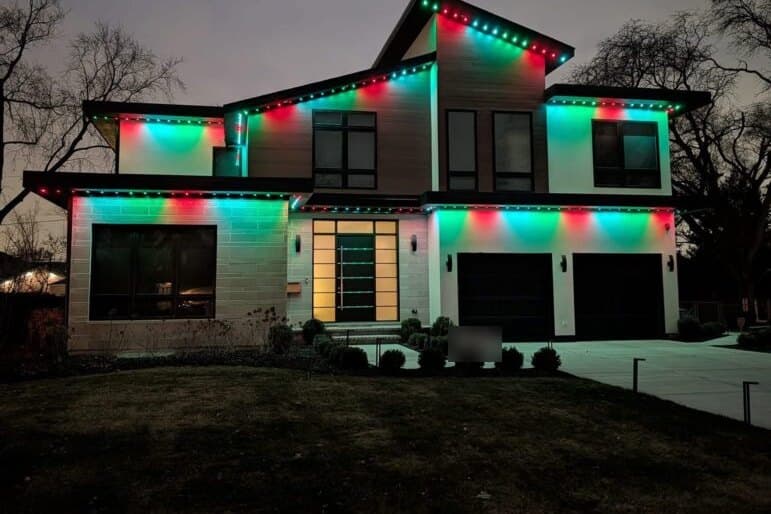
Top Permanent Lighting Installers in San Elizario, TX
Also looking for Christmas lights? See Christmas Light Installers in San Elizario, TX →
Permanent Lighting Installation in San Elizario, TX
San Elizario sits in a genuine high desert climate, and that climate stresses outdoor lighting hardware at both ends of the thermometer rather than just one. The nearest long-term weather station, El Paso International Airport about 18 miles north-northwest, averages 42 nights a year at or below 32 degrees under its 1991-2020 normals, concentrated from late November through January, so any fixture mounted to a fascia has to survive a real overnight freeze-thaw cycle again and again through the winter. The same record shows 118 days a year at 90 degrees or hotter and 28 days at 100 degrees or more, mostly from June through August, with annual precipitation running a dry 8.8 inches — which means intense, sustained ultraviolet exposure rather than rain is the other half of the stress test. Seasonal strands are built for a few weeks outdoors followed by a dark storage shed; they are not built to sit through either a desert summer or a desert winter held for months at a stretch, which is why so many boxes of consumer lights come out already brittle and faded by the time anyone plugs them back in. A sealed aluminum channel holding the diodes back from direct sun and direct frost handles San Elizario's actual range — hard freeze, hard heat, and a dry UV load all year — better than anything re-hung by hand each winter. That matters more here than in a milder climate precisely because the swing between the two extremes happens every year without fail, not as an occasional bad season.
Cost comes down to measurable things rather than a number anyone can quote sight unseen: total linear footage of roofline and trim, the brand and fixture family chosen, and how many corners the building's layout forces the channel to navigate. Those variables differ meaningfully across San Elizario's mix of older adobe construction in the historic core near the plaza and newer stucco-over-frame homes built further out. An older adobe building with thick walls and a simple, low roofline is one kind of job, with its own anchoring considerations; a newer two-story stucco home with multiple gables is a different and typically larger one, and an honest quote reflects which situation applies rather than flattening both into the same figure. Homeowners who have paid for seasonal installation and takedown year after year sometimes find the math shifts once that twice-a-year labor stops being a recurring cost, though exactly where that line falls depends entirely on the property and system chosen — there's no flat number that applies evenly across every building in town. A free quote from someone who has actually walked your roofline, adobe or stucco, is the only way to see real figures for your specific property. Getting more than one quote is worth the time, but make sure each one covers the same scope — a front-facing run only versus the full perimeter of the building are very different amounts of channel, and the lower-looking number is often just the smaller job wearing a different price tag.
The part homeowners tend to underrate is what a permanent system does for the other eleven months. App control means the same channel that runs a full holiday display in December can hold a plain warm white for everyday curb appeal the rest of the year, then switch for whatever the calendar calls for — a specific color run for a San Elizario ISD game day, red-white-and-blue through the Fourth of July, orange for Halloween, or a soft accent on the entry the rest of the time. That flexibility has a practical edge in a town built around a nineteenth-century plaza core, where an adobe building a block from the chapel and a newer home further out both tend to favor a settled, low-key daytime look rather than visible hardware hanging off the fascia year-round. A system that returns to one uniform default the moment a holiday ends is simpler to live with than strands nobody got around to taking down before the next heat wave bakes the plastic brittle. It's worth asking an installer directly during the walkthrough how discreet the channel looks in daylight against an adobe wall versus a stucco one, and whether the extrusion color can be matched to either. In a town where the historic plaza draws a steady trickle of visitors year-round, a system that looks clean and intentional in the daytime — not just after dark — carries real weight for anyone living or doing business close to that core.
Installation on a typical San Elizario home runs about a day once the walkthrough and measurement are done, though the specifics shift depending on which part of town a building sits in. In the historic core near the plaza, thick adobe or plastered-adobe walls change how a channel gets anchored compared to a standard stucco-over-frame house, and an installer who hasn't worked an adobe building before should say so rather than guess at the fastening on site — adobe doesn't take a standard screw-and-anchor approach the way framed construction does, and getting that wrong risks real damage to a wall that's been standing since the nineteenth century in some parts of the historic core. On the newer residential streets further out, standard stucco construction with composition-shingle roofs takes a more conventional mounting approach, and the channel run is mostly a matter of following the gable lines cleanly. Power drop location, transformer placement, and how the controller reaches a home's wifi network all get settled during the same walkthrough — a controller mounted somewhere the signal is weak turns a good system into a frustrating one almost immediately after the crew leaves. Because there's no narrow seasonal window the way there is for a holiday-only crew, installers have more flexibility on scheduling, and daylight rather than weather tends to be the practical limit for most of the year in a climate this dry.
The permanent lighting brands you'll run into around San Elizario include Jellyfish Lighting, Trimlight, EverLights, Gemstone Lights, and Oelo. They differ in fixture profile, channel design, app behavior, how many individually addressable zones a single run supports, and how cleanly the controller ties into a home network, so which brand a given installer actually carries is a fair opening question rather than a detail to sort out after the deposit is paid. Ask which systems an installer is trained on and how long they've been mounting that particular brand, since the quality of the mounting matters at least as much as which hardware ends up on the wall — especially on an adobe building, where anchoring choices differ from a standard stucco or frame house. Warranty coverage and support terms vary by brand and by installer, so get them in writing instead of assuming one company's terms apply to every system on the market. None of the brands above should be described as certifying or background-checking the installer who carries them — the brand relationship means the installer works with that system's hardware and app, nothing more, and any claim beyond that is worth questioning directly. It's also worth asking what happens if a single diode fails several years out, and whether replacement fixtures for that exact channel profile are still available by then — a permanent system is a decade-scale purchase, and serviceability deserves real attention up front.
Commercial and civic permanent lighting has a straightforward appeal around San Elizario's historic plaza: the fixtures never have to come down and go back up around a fall-into-winter school calendar or a civic event schedule. Storefronts and civic buildings fronting the plaza can run a full holiday display and then a subdued architectural accent the rest of the year from the same installed hardware, without rescheduling a seasonal crew every November. San Elizario ISD's campuses are candidates for the same approach on athletic facilities or entrances, trading an install-and-remove cycle for occasional fixture replacement instead. There's a safety angle too: a seasonal display on a commercial or civic building means putting someone on a ladder or lift twice a year, often during the valley's coldest early-morning stretch; a permanent system moves that exposure to one planned day the crew picks for itself rather than one the calendar forces on them. For a property near the plaza, there's a practical upkeep benefit too: a fixed, low-profile channel sealed against the valley's dry heat and hard winter freeze needs far less year-to-year attention than a seasonal strand re-clipped on by hand every few months.
Homeowners and business or civic property owners in San Elizario can request a free quote through Lights Local and compare installers working with different permanent lighting systems before committing to one. There's no single number that applies evenly across town — an older adobe building near the plaza and a newer stucco home further out need different anchoring approaches and different fixture counts, and an honest quote reflects that rather than flattening both into one figure. Getting two or three walkthroughs scheduled before the valley's short winter daylight sets in is the practical move, since the same conditions that compress a seasonal install schedule also make for a better-lit walkthrough earlier in the year. Bring the same details to each visit — building age and wall material, number of stories, and what you want lit beyond the roofline — so the quotes you get back are actually comparable. San Elizario's entire incorporated area shares one ZIP code, 79849, so there's no need to guess which part of town a quote request will route to — entering it surfaces installers who actually cover the town rather than a neighboring community along the same stretch of river. Enter your ZIP code to see which permanent lighting installers serve your part of San Elizario.
San Elizario Neighborhoods and Areas Served
Our San Elizario permanent lighting installers serve homeowners and businesses across this stretch of the Rio Grande valley, from the historic plaza core to the surrounding El Paso County towns:
Browse all permanent lighting installers in El Paso County or use your ZIP code to find pros near you.
ZIP Codes Served
79849
Nearby Cities
Written by Matt Staton, founder of Strandr, the design software used by 1,700+ professional lighting contractors.
Lights Local checks the installers it lists. More about how Lights Local works → · What installation costs → · Buyer's guides →
Get a Free Quote
Verified pros in San Elizario, TX — free, no obligation.
Tell us a few quick details and we'll match you with a local installer. Most pros respond within an hour.
Get Free QuoteFree, no obligation. A local pro will reach out directly.